Your Coverage, Your Way.
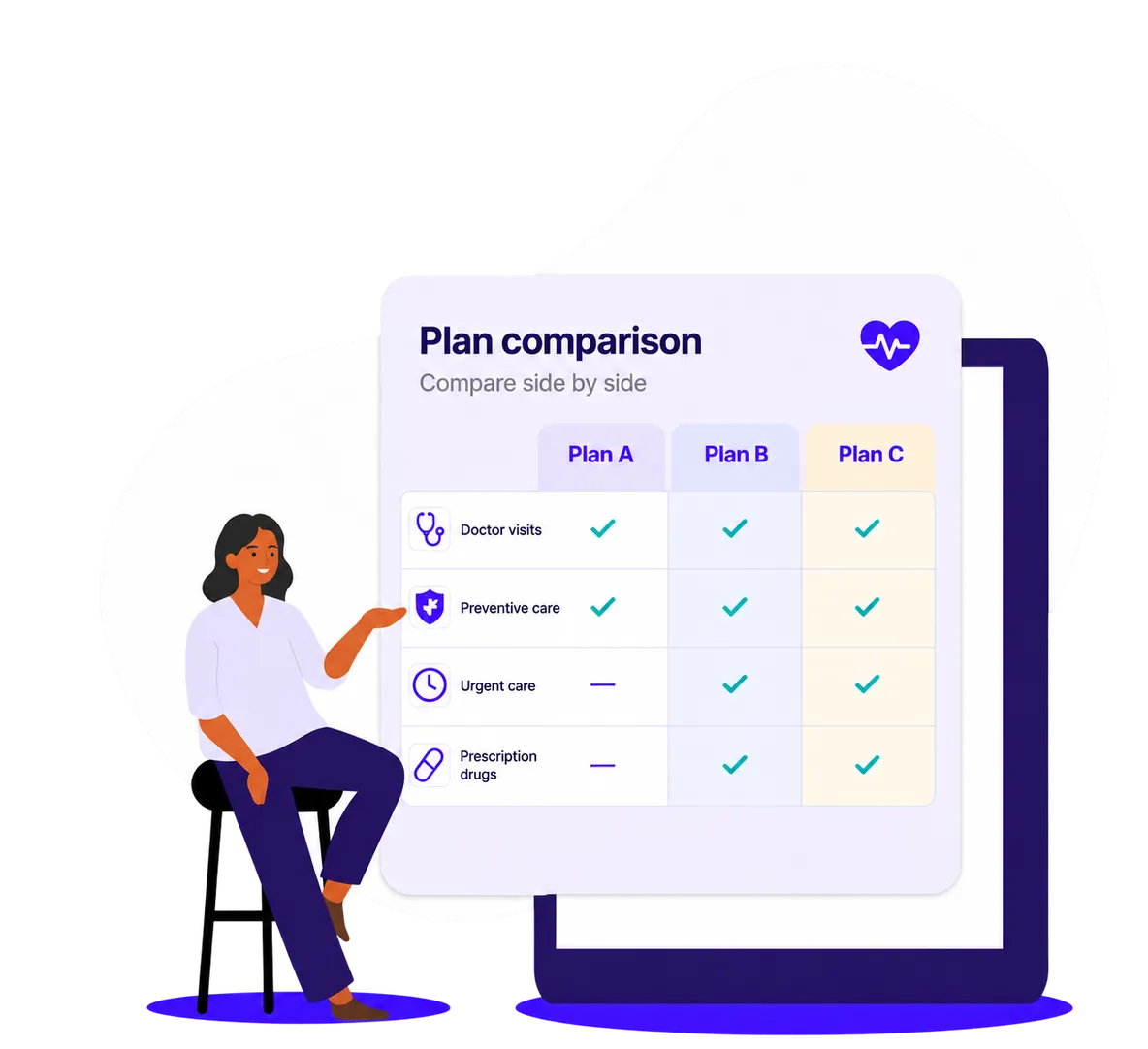
Compare plans side by side and find coverage that fits your life and your budget.
- Licensed Nationwide
- A+ BBB Rating
- 12,000+ customers helped
Six ways to get covered.
- Licensed Nationwide
- Marketplace Certified Agents
- No Obligation
- Options for Most Situations


Our process
Choose coverage with confidence
Our simple 4-step selection process puts you in complete control.
- 1
Share
Answer a few quick questions about your needs
- 2
Connect
A licensed insurance agent walks you through plans available in your area
- 3
Compare
See costs and benefits side by side to find the right fit.
- 4
Enroll
Your licensed insurance agent helps you sign up and answers questions along the way.


The questions we hear most.
No jargon. Just straight answers.
See all FAQs
Still have questions? Talk to us.
Our licensed insurance agents are here to answer your questions and help you find the right plan.

Mon-Fri 8am-6pm CT — TTY 711
At Covly, we believe choosing a health insurance plan shouldn't be overwhelming. As a licensed insurance agency, we're not tied to a single carrier, and help you compare plans.Our agents break down premiums, deductibles, metal tiers, enrollment windows, and subsidy eligibility in plain language to help you make confident decisions. No pressure, no jargon, and no unexplained fine print. We're here before you enroll, during the comparison process, and after, because the right coverage isn't about simply finding a plan. It's about finding a plan that fits your life.
For ACA plans, Open Enrollment typically runs November 1 through January 15 in most states, and outside that window you need a Special Enrollment Period triggered by a qualifying life event like losing job coverage, moving to a new zip code, marriage, or having a baby.
It depends on your household income, size, and the plan you choose, but a lot of people are surprised by how affordable coverage can be once subsidies are factored in. Premium tax credits are available to households earning between 100% and 400% of the federal poverty level, and lower-income enrollees on Silver plans may also qualify for cost-sharing reductions that lower deductibles and copays significantly. The best way to know what you'd actually pay is to run the numbers for your specific situation, and that's something we do every day at no cost to you
Maybe, and it's worth checking before you enroll, not after. Whether your doctors are in-network depends on the specific plan, not just the plan type. HMO plans restrict you to a defined network; PPO plans give you more flexibility including partial out-of-network coverage. Your medications matter too. The same prescription can sit at a low-cost tier on one plan and a high-cost tier on another. We check both before recommending anything.
For ACA Marketplace plans, no. Insurers are required by law to cover pre-existing conditions and cannot charge you more because of your health history, regardless of how serious the condition is. Short-term plans and health sharing ministries are a different story, as both commonly exclude pre-existing conditions. If you have ongoing health needs, knowing which coverage type protects you is the most important part of the conversation.
Short-term health insurance is temporary coverage designed to fill a defined gap. Between jobs, waiting for employer benefits to kick in, or bridging to the next Open Enrollment Period. It costs significantly less than an unsubsidized ACA plan, and coverage can start within 24 to 48 hours of approval. The tradeoff is real: short-term plans don't cover pre-existing conditions or the essential health benefits, and aren't a long-term substitute for comprehensive coverage. For a generally healthy person who needs something in place while they figure out their next move, it can be a smart choice. For someone managing ongoing health needs, an ACA plan is almost always the better fit. Not sure which side of that line you're on? That's exactly what we're here to help you figure out.
Articles

Private Health Insurance vs. Health Insurance Marketplace
ACA Marketplace
Both private and Marketplace health insurance are sold by private insurers. The difference is where you buy and what rules apply. Marketplace plans, bought through HealthCare.gov or a state exchange, are always ACA-compliant and may come with income-based financial assistance. Private plans bought off-Marketplace range from ACA-compliant to non-ACA products like short-term plans.
Read full article

What Is the Health Insurance Marketplace?
ACA Marketplace
The Health Insurance Marketplace is the ACA platform for buying individual coverage. You compare standardized plans by metal tier and plan type, see whether you qualify for premium tax credits, and enroll during Open Enrollment or a Special Enrollment Period.
Read full article
What Is an EPO Plan?
EPO
An EPO, or Exclusive Provider Organization, is a health plan that covers care only within its network. Unlike an HMO, it needs no primary care physician or referrals to see in-network specialists. Outside the network, only emergencies are covered. EPOs sit between HMOs and PPOs on cost and flexibility
Read full article
Health Insurance Basics: A Guide to Understanding Health Insurance Before You Buy
Health Insurance Basics
Health insurance shares your medical costs in exchange for a monthly premium. You pay through premiums, deductibles, copays, and coinsurance until you reach your out-of-pocket maximum after which the plan covers the rest. Plan types such as HMO, PPO, EPO, and POS set how you access care.
Read full article
What Is an HMO Plan?
HMO
An HMO, or Health Maintenance Organization, is a health plan that covers care only within its network. You choose a primary care physician who coordinates your care and issues referrals to specialists. Outside the network, only emergencies are covered. HMOs carry the lowest average premiums of the major plan types.
Read full article
What Is a PPO plan?
PPO
A PPO, or Preferred Provider Organization, is a health plan that covers both in-network and out- of-network care, though out-of-network costs more. It requires no primary care physician and no referrals to see specialists. PPOs offer the most provider flexibility of the major plan types, at the highest average premium.
Read full article
Health Insurance Enrollment Periods and Qualifying Life Events
OEP
Enrollment periods are defined windows for signing up for or changing health insurance, while qualifying life events such as job loss, marriage, or a birth trigger a Special Enrollment Period outside those windows, typically lasting 60 days from the date of the event.
Read full article
What Is Short-Term Health Insurance and Is It Right for You?
Short-Term Medical
Short-term health insurance is temporary coverage designed to fill a defined gap, such as between jobs or waiting for employer benefits to begin. It costs less than ACA coverage because insurers can underwrite health history, exclude pre-existing conditions, and omit benefits ACA plans must cover.
Read full article
What Is Fixed Indemnity Health Insurance?
Fixed Indemnity
Fixed indemnity health insurance pays you a predetermined dollar amount when a covered medical event occurs, such as a hospital day or doctor visit, regardless of the actual bill. It supplements comprehensive coverage, paid directly to you to offset deductibles, coinsurance, and other out-of-pocket costs.
Read full article
What Is a Health Care Sharing Ministry?
Health Sharing Ministry
A health care sharing ministry is a membership organization in which members pool monthly contributions to help cover each other's medical expenses. It is not insurance: no contract guarantees payment, and sharing follows the organization's guidelines rather than insurance law or ACA consumer protection rules.
Read full article
What Is Supplemental Health Insurance? A Guide to Filling the Gaps in Your Coverage
Supplemental Insurance
Supplemental health insurance is a category of products that work alongside primary coverage, paying benefits directly to you to offset deductibles, copays, coinsurance, and non-medical costs of a health event. Common types include critical illness, fixed indemnity, accident, hospital indemnity, dental, and vision.
Read full article
Dental and Vision Insurance: What They Cover, Why You Need Them, and How to Choose
Dental Insurance
Standard health insurance does not cover routine adult dental or vision care. Dental insurance offsets preventive, basic, and major dental work, typically on a 100/80/50 structure with an annual maximum; vision insurance covers annual exams and provides allowances toward glasses or contact lenses.
Read full articleReady to find the right coverage for you?
We’re here to help you make the right decision.